


Concrete Paving Equipment for Sale: Slipform Pavers, Screeds, and Finishing Machines Compared
Selecting the right concrete paving equipment for sale is a mission-critical decision for contractors who want to deliver durable, high-quality pavements efficiently. While the term “concrete paving equipment” can encompass a wide range of tools and machinery, three categories are especially central to modern paving operations: slipform pavers, screeds, and finishing machines. Each type plays a specific role in the paving process, and understanding their differences can help buyers match equipment to application, budget, and productivity requirements.
This article provides a clear comparison of these three equipment types — their functions, strengths, limitations, and how they influence pavement quality and construction efficiency.
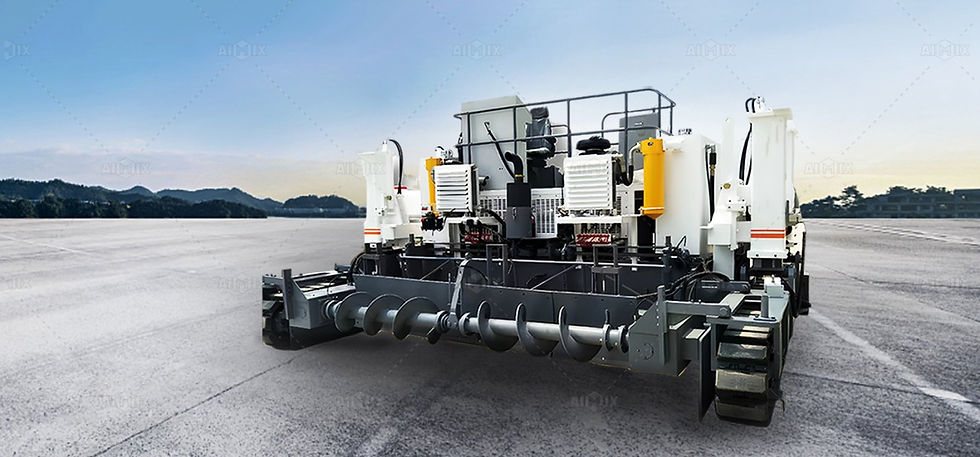
1. Slipform Pavers: Automated Precision for Large Projects
Slipform pavers are among the most versatile and productive pieces of concrete paving equipment for sale. Designed for continuous paving, slipform pavers extrude concrete into a designed profile without the need for fixed side forms. Instead, they rely on hydraulically controlled molds and screeds to shape the concrete as the machine moves forward.
This automatic forming process makes slipform pavers particularly valuable on long-distance highway projects, airport runways, and large industrial slabs, where consistent profile accuracy and smooth surface finish are essential. Because of their continuous operation, these machines significantly reduce cycle times and labor compared to traditional form-and-strike-off methods.
Slipform pavers vary in size and capacity. Large stationary models can handle 6–12 m paving widths and high production rates, while smaller crawler or trailer-mounted units suit urban streets and narrower lanes. When evaluating concrete paving equipment for sale, buyers should check factors like paving width range, engine power, automation features, and material feed systems. Higher automation — such as grade and slope control — enhances precision and reduces dependency on manual crew skills, resulting in faster, more consistent outputs.
Performance consistency is another key advantage. Slipform technology maintains alignment and elevation via onboard sensors and automatic control, which minimizes surface irregularities and improves ride quality. However, these capabilities come with higher purchase prices and require skilled operators and maintenance teams. For contractors with frequent highway or large paving contracts, the productivity gains often justify the investment.
2. Screeds: Simple, Flexible, and Cost-Effective
Screeds are essential concrete paving equipment for sale that range from simple manual tools to sophisticated vibratory systems. The term “screed” typically refers to the device used to level and smooth freshly placed concrete following placement. In basic terms, a screed can be as simple as a straightedge pulled by hand over the concrete surface.
More advanced screeds include vibratory screeds, which use powered vibration to compact concrete and improve surface consolidation. These can be standalone handheld units or part of a tow-behind assembly pulled by small tractors or loaders. Vibratory screeds significantly improve finish quality over hand-leveling alone, especially on medium-sized slabs and residential projects.
Screeds are especially popular when budgets are limited or for small to medium paving jobs where full slipform operation may not be justified. They allow contractors to control surface flatness locally, and portable options make them easy to transport between job sites. Because screeds are simpler in design and operation, they also require less specialized training and maintenance.
However, screeds have limitations compared to slipform pavers. They are typically less productive for large continuous pours and depend heavily on operator skill. Manual vibration and leveling require coordination, and achieving consistent grade and finish over long distances is more challenging. For projects with tight tolerances or high output demands, contractors often pair screeds with other machinery or choose slipform technology instead.

3. Finishing Machines: Enhancing Surface Quality and Texture
After initial leveling, many paving jobs call for finishing machines — specialized concrete paving equipment for sale that focus on producing the final surface quality and texture required by specifications. Finishing machines include trowels, power floats, and texturing equipment that refine surface smoothness, densify the top layer, and add desired patterns (e.g., broom finish or exposed aggregate).
Ride-on trowels and walk-behind power trowels are common examples. These machines deliver high-speed rotation and precise control, resulting in a dense, hard surface that reduces dusting and improves abrasion resistance. Trowels are essential for industrial slabs, warehouses, and high-traffic pavements where durability is critical.
Specialized texturing attachments help create skid-resistant surfaces on roads and runways. Broom finishers, for example, add transverse grooves that improve tire grip and drainage performance. When contractors evaluate concrete paving equipment for sale, they should consider the range of finishing attachments available and how they integrate with their existing equipment fleet.
Finishing machines do not replace slipform pavers or screeds; rather, they complement them. While slipform and screeds establish the base level and profile, finishing machines ensure that the surface meets aesthetic and performance standards. For contractors aiming to deliver premium quality with minimal touch-ups, investing in advanced finishing systems can significantly improve end results.
4. Choosing the Right Equipment: Matching Tools to Needs
Selecting the right concrete paving equipment for sale depends on the scale of work, budget, desired quality, and operational capabilities of the contracting team. For large continuous tasks like highways, airport runways, or city arteries, slipform pavers excel in productivity, automation, and consistency. Their investment pays off in reduced labor and improved production rates.
For smaller or budget-conscious projects, screeds offer a flexible and cost-effective pathway to quality paving — especially when paired with vibratory features that enhance compaction and surface uniformity. Meanwhile, finishing machines serve as the final quality enhancer, ideal for projects that demand specific textures, durability, or architectural surfaces.
Contractors should also evaluate serviceability, spare parts availability, and local dealer support when considering concrete paving equipment for sale. High-tech models require training and long-term support, and choosing reputable suppliers like Aimix can protect uptime and ROI.

Conclusion
Slipform pavers, screeds, and finishing machines each occupy distinct roles in modern concrete paving operations. A comparative understanding of their capabilities helps buyers make smarter decisions when purchasing concrete paving equipment for sale. By focusing on productivity drivers — from automation and precision to finish quality — contractors can match equipment choices to project demands, driving better outcomes and business growth.


Comments