


Concrete Paving Machines Engineered for Consistent Surface Finishing
In modern infrastructure construction, surface quality is no longer judged only by appearance. Flatness, smoothness, durability, and long-term performance all depend on how accurately concrete is placed, leveled, compacted, and finished. This is why concrete paving machines engineered for consistent surface finishing have become essential equipment for road contractors, airport developers, and industrial pavement builders worldwide. By integrating precise mechanical design with advanced control technology, modern paving machines ensure uniform results across long paving distances and complex jobsite conditions.

Why consistent surface finishing matters
Consistent surface finishing directly affects pavement lifespan and user experience. Uneven surfaces can lead to premature cracking, poor drainage, increased maintenance costs, and reduced safety. For highways and urban roads, surface smoothness influences driving comfort and fuel efficiency. For airports and industrial floors, strict flatness tolerances are critical for heavy loads and high-speed operations.
Manual finishing methods struggle to maintain uniformity over large areas. Variations in operator skill, concrete consistency, and environmental conditions introduce unavoidable inconsistencies. Concrete paving machines address these challenges by standardizing paving processes, minimizing human error, and maintaining stable operating parameters throughout the job.
Engineering design for surface accuracy
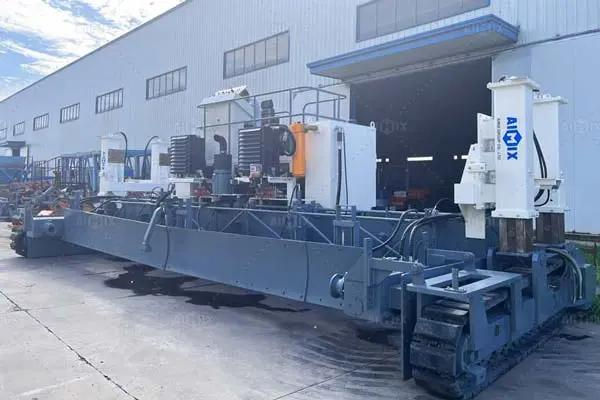
The foundation of consistent finishing lies in the structural design of the paving machine. A rigid main frame with high torsional strength prevents deformation during operation, even under uneven loads. This structural stability ensures that screeds and finishing components maintain consistent elevation and alignment.
Precision-engineered screeds are another key element. Their geometry, vibration frequency, and surface treatment are designed to evenly distribute concrete and eliminate surface irregularities. Adjustable screed widths allow contractors to adapt to different lane sizes without compromising finishing quality.
Intelligent leveling and control systems
Modern concrete paving machines rely heavily on intelligent control systems to maintain surface consistency. Sensors, laser guidance, stringline systems, or 3D machine control continuously monitor paving height and slope. The control system makes real-time adjustments to ensure accurate elevation and cross-slope, even when subgrade conditions vary.
These systems significantly reduce dependency on manual adjustments and allow machines to maintain uniform results over long distances. For large-scale infrastructure projects, such automation is essential to meet strict flatness and smoothness specifications.
Vibration and compaction technology
Effective vibration is critical for achieving a dense, uniform concrete surface. Modern paving machines integrate optimized vibration systems that consolidate concrete without causing segregation. Controlled vibration frequency and amplitude ensure that air voids are removed while aggregates remain evenly distributed.
Some advanced machines allow operators to adjust vibration parameters based on concrete mix design and paving thickness. This adaptability improves surface finish consistency across different project types, from thin urban pavements to thick industrial slabs.

Material flow and distribution control
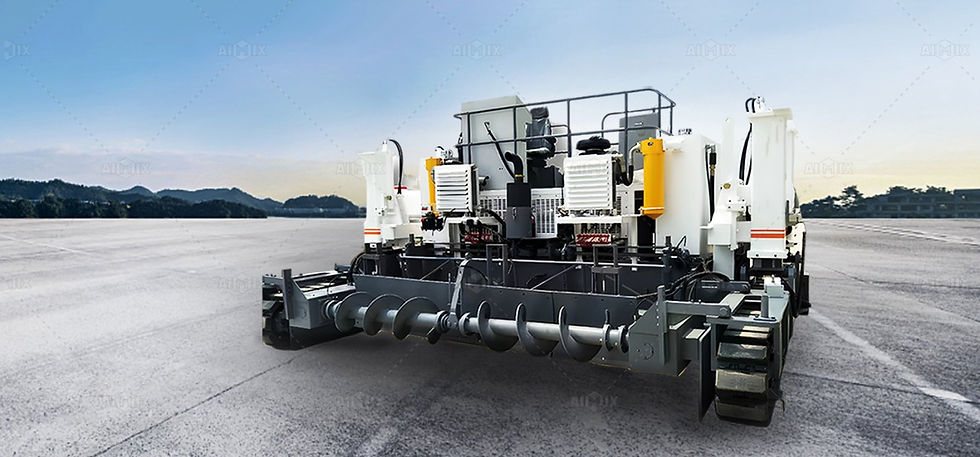
Consistent surface finishing also depends on how evenly concrete is delivered and spread in front of the screed. Advanced concrete paving machines use optimized augers, spreaders, and flow control systems to maintain a uniform head of material across the paving width.
Stable material flow prevents localized overfilling or shortages that can lead to surface defects. By maintaining consistent pressure against the screed, the machine produces a smooth, continuous finish that requires minimal corrective work.
Adaptability to varying site conditions
Jobsite conditions rarely remain constant. Changes in temperature, concrete workability, and base layer quality can affect surface finishing. Concrete paving machines are engineered to adapt to these variables through adjustable operating parameters and responsive control systems.
For example, machines can compensate for slight subgrade irregularities, adjust travel speed, or modify vibration intensity in response to real-time conditions. This adaptability ensures consistent finishing quality, even in challenging environments.
Benefits for contractors and project owners
Investing in concrete paving machines engineered for consistent surface finishing offers measurable advantages:
Improved pavement quality, reducing early maintenance and repair costs.
Higher productivity, as automated finishing minimizes rework and downtime.
Better compliance with specifications, especially for large infrastructure projects.
Lower labor dependency, allowing crews to focus on quality monitoring rather than manual correction.
Enhanced project reputation, as consistent results reflect professional execution.
Over time, these benefits translate into stronger competitiveness and improved return on investment for contractors. If you are looking for a reliable concrete paver now for your road paving projects, please just contact Aimix to get product details and free quotation to suit all your requirements.
Future trends in surface finishing technology
As digital construction advances, concrete paving machines are becoming smarter and more connected. Integration with BIM models, GPS-based control, and real-time data logging will further enhance surface consistency. These technologies allow contractors to document quality, analyze performance, and continuously optimize paving processes.
In parallel, sustainability considerations are influencing machine design. Efficient vibration systems, optimized material use, and compatibility with low-carbon concrete mixes ensure that surface finishing quality aligns with environmental goals.
Conclusion
Concrete paving machines engineered for consistent surface finishing represent the convergence of mechanical precision, intelligent control, and practical jobsite adaptability. By delivering uniform, high-quality surfaces across diverse projects, these machines play a critical role in modern infrastructure development. For contractors seeking long-term performance, reduced rework, and superior pavement quality, investing in advanced concrete paving machines is no longer optional—it is a strategic necessity.


Comments