


Essential Concrete Paving Equipment Required for High-Quality Pavement Construction
High-quality concrete pavement depends on much more than a well-designed concrete mix. The construction process requires a complete set of concrete paving equipment to ensure accurate material placement, proper compaction, smooth surface finishing, and effective curing. Whether the project involves highways, airport runways, industrial yards, or municipal roads, selecting the right equipment directly affects pavement durability, ride quality, construction efficiency, and long-term maintenance costs. Understanding the role of each machine helps contractors optimize workflow, reduce labor requirements, and consistently achieve high construction standards.

Concrete Batching Plant: Producing Consistent Concrete
Every successful paving project begins with high-quality concrete production. A concrete batching plant accurately measures cement, aggregates, water, and admixtures to produce concrete with consistent strength and workability. Modern batching plants use automated weighing systems and computerized controls to minimize human error and improve batching precision.
The production capacity of the batching plant should match the paving schedule. Insufficient concrete supply can interrupt paving operations, resulting in cold joints and reduced pavement quality. On large infrastructure projects, high-capacity batching plants equipped with twin-shaft mixers are commonly used to provide continuous concrete production throughout the paving process.
Concrete Mixer Trucks: Maintaining Fresh Concrete During Transportation
After batching, concrete must be transported efficiently from the production plant to the construction site. Concrete mixer trucks continuously rotate the mixing drum during transportation, preventing material segregation and maintaining uniform consistency until discharge.
Proper transportation management is especially important for projects located far from batching plants. Delays may reduce concrete workability and negatively affect finishing quality. Coordinating the number of mixer trucks with paving speed helps maintain a continuous supply of fresh concrete while minimizing waiting time.
Slipform Paver: The Core Concrete Paving Equipment
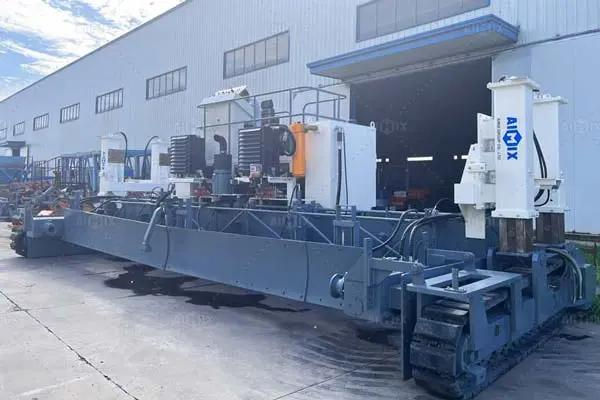
Among all types of concrete paving equipment, the slipform paver is one of the most important machines for modern road construction. Unlike traditional fixed-form methods, slipform pavers continuously place, shape, compact, and finish concrete without requiring side forms.
Equipped with automatic steering systems, grade controls, and vibration units, slipform pavers produce uniform pavement thickness, smooth surfaces, and accurate alignment. They significantly improve construction speed while reducing labor requirements, making them the preferred choice for highways, airport runways, and other large-scale paving projects.
Modern slipform pavers also feature GPS guidance and intelligent control systems that further improve paving accuracy and productivity.

Concrete Spreader: Distributing Concrete Evenly
Before final paving, freshly delivered concrete must be distributed evenly across the paving width. Concrete spreaders perform this task by moving concrete to the required thickness and ensuring consistent material distribution ahead of the paver.
Uniform concrete distribution reduces unnecessary machine adjustments and helps the paving equipment maintain a stable operating speed. Even material placement also contributes to better surface quality and consistent pavement thickness across the entire project.
Internal and Surface Vibrators: Eliminating Air Voids
Proper concrete compaction is essential for pavement strength and durability. Internal vibrators integrated into slipform pavers remove trapped air while ensuring concrete completely fills every section of the pavement.
Surface vibrators may also be used during certain applications to improve concrete density and create a more uniform surface texture. Effective vibration reduces honeycombing, increases compressive strength, and improves resistance to freeze-thaw cycles and heavy traffic loads.
Operators must carefully control vibration intensity because excessive vibration can cause aggregate segregation, while insufficient vibration leaves unwanted air pockets inside the concrete.
Concrete Finishing Equipment: Achieving a Smooth Surface
Once the concrete has been placed and compacted, finishing equipment is used to produce a smooth and level pavement surface. Depending on project requirements, contractors may use oscillating screeds, power trowels, straightedges, or automated finishing machines.
Proper finishing removes minor surface imperfections, improves riding comfort, and prepares the pavement for texturing. Accurate finishing is particularly important for highways and airport pavements, where strict smoothness standards directly influence vehicle performance and safety.
Automated finishing equipment also improves consistency by reducing the influence of manual workmanship.
Texturing Equipment: Improving Pavement Safety
Concrete pavement requires adequate surface texture to provide sufficient skid resistance during wet weather. Texturing equipment creates grooves or brushed finishes that improve tire grip while reducing hydroplaning risks.
Longitudinal tining, transverse tining, and artificial turf dragging are among the most common texturing methods. The choice depends on local design standards, traffic conditions, and environmental requirements.
Proper texturing not only enhances driving safety but also contributes to better drainage and longer pavement service life.
Curing Equipment: Protecting Fresh Concrete
Concrete curing begins immediately after finishing. Curing equipment applies curing compounds or water evenly across the pavement surface to prevent rapid moisture loss during the hydration process.
Maintaining adequate moisture allows concrete to develop its designed strength while reducing the risk of shrinkage cracks and surface defects. On large paving projects, self-propelled curing machines provide consistent application speed and complete surface coverage.
Proper curing is one of the most cost-effective methods for improving long-term pavement durability and minimizing future maintenance expenses.
Joint Cutting Equipment: Preventing Random Cracking
Concrete naturally shrinks as it hardens, making joint construction an essential part of pavement design. Concrete saws create precise contraction joints that control where shrinkage cracks occur.
Joint cutting should be performed at the appropriate time after concrete placement to minimize uncontrolled cracking. Modern diamond-blade saws provide clean, accurate cuts while maintaining high productivity across large paving areas.
Well-designed joint systems improve pavement performance and reduce long-term repair costs.

Inspection and Quality Control Equipment
Quality control is an important component of every paving project. Contractors use laser levels, thickness measurement tools, slump testing equipment, air content meters, temperature sensors, and strength testing devices to verify construction quality throughout the paving process.
Regular inspections help identify potential problems before they become costly defects. Continuous monitoring also ensures that every stage of construction complies with project specifications and industry standards.
Advanced digital monitoring systems now allow project managers to track production data, paving accuracy, and equipment performance in real time, further improving construction efficiency.
Conclusion
High-quality pavement construction depends on a complete and well-coordinated system of concrete paving equipment rather than a single machine. From concrete batching plants and mixer trucks to slipform pavers, vibrators, finishing machines, texturing equipment, curing systems, joint saws, and quality inspection tools, each piece of equipment plays a vital role in achieving durable, smooth, and safe concrete pavements. By selecting reliable equipment and following proper construction procedures, contractors can improve productivity, reduce operating costs, and deliver pavement projects that provide excellent performance and long service life.
Comments