


How Concrete Paving Machine Manufacturers Meet the Requirements of Airport Pavement Projects
Airport pavement projects demand a higher level of precision, durability, and construction efficiency than many conventional road projects. Runways, taxiways, aprons, and other airfield pavements must withstand repeated aircraft loads while maintaining strict requirements for flatness, thickness, and surface quality. For this reason, concrete paving machine manufacturers need to develop equipment that can deliver consistent paving performance, adapt to large-scale construction conditions, and support contractors throughout the project.
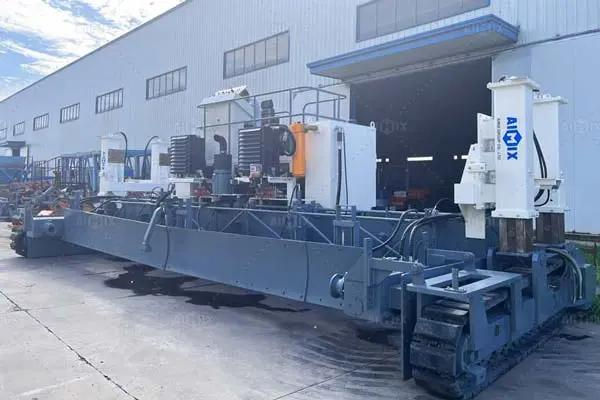
1. Designing Concrete Paving Machines for Large Airport Pavements
Airport pavement construction often involves wide paving areas and long continuous sections. Concrete paving machine manufacturers therefore focus on developing machines with suitable paving widths, high working efficiency, and stable material distribution systems. A properly configured machine can reduce the number of passes required and help contractors maintain a more continuous paving operation across large runway or taxiway sections.
Machine stability is equally important. During airport pavement construction, even minor variations in paving height or concrete distribution can affect the final pavement quality. Manufacturers improve frame strength, hydraulic systems, leveling mechanisms, and operating controls to maintain stable machine movement and consistent paving thickness across the working width.
2. Improving Paving Accuracy and Surface Flatness
Flatness is one of the most important requirements for airport pavement because irregular pavement surfaces can affect aircraft operations and increase long-term maintenance requirements. Concrete paving machine manufacturers incorporate automatic leveling and control systems to help maintain the designed elevation while the machine moves continuously along the pavement.
Advanced paving systems can coordinate machine movement, concrete distribution, vibration, and leveling processes. This allows the equipment to maintain more consistent pavement thickness and surface elevation. For contractors, improved paving accuracy can also reduce the amount of subsequent correction work and contribute to a more uniform finished pavement.
3. Ensuring Uniform Concrete Distribution and Compaction
Airport pavement commonly uses large quantities of concrete, making consistent material distribution essential. If concrete is distributed unevenly before finishing, certain areas may receive insufficient material while others may require additional adjustment. Concrete paving machine manufacturers address this issue through optimized spreading and distribution systems that help maintain a relatively uniform concrete layer ahead of the finishing process.
Vibration is another critical part of the paving operation. Proper vibration helps consolidate concrete and reduce internal voids while maintaining the required density and structural performance. Manufacturers therefore pay close attention to vibration frequency, amplitude, and system configuration so that concrete can be effectively compacted across different paving conditions without unnecessarily affecting the mix.

4. Supporting Continuous and Efficient Airport Construction
Airport projects often operate under strict construction schedules because runway and taxiway closures can affect airport operations. Equipment downtime can therefore create significant project delays. Concrete paving machine manufacturers focus on machine reliability, simplified maintenance, and durable components to help contractors maintain continuous production during demanding paving operations.
High working efficiency also depends on coordination between the concrete batching plant, transportation system, and paving machine. When sufficient concrete can be delivered continuously to the paving area, the machine can operate with fewer interruptions. Manufacturers can provide equipment configurations that match the project's concrete supply capacity and paving requirements, helping contractors create a more efficient overall construction workflow.
5. Adapting Equipment to Different Airport Pavement Requirements
Not every airport pavement project has identical requirements. Runways may involve extensive continuous paving, while taxiways and aircraft aprons can have different dimensions, layouts, and construction conditions. Concrete paving machine manufacturers need to provide flexible configurations that allow equipment to accommodate different paving widths, working speeds, and site conditions.
Construction environments can also vary significantly between airports. Temperature, humidity, aggregate characteristics, concrete mix design, and local construction standards may all influence paving performance. Experienced manufacturers including AIMIX work with contractors to select appropriate machine configurations and operating parameters rather than applying the same equipment setup to every project.
6. Providing Technical Support Beyond Equipment Manufacturing
Meeting airport pavement requirements is not only about supplying a machine. Equipment installation, commissioning, operator training, maintenance guidance, and technical support can all influence the final construction result. Reliable concrete paving machine manufacturers typically provide technical assistance to help contractors understand machine operation and configure the equipment correctly for their projects.
Spare parts and after-sales service are also important for large infrastructure projects. If a critical component fails during continuous paving, delays can quickly increase project costs. Manufacturers with responsive service capabilities and sufficient spare parts support can help contractors reduce downtime and maintain stable construction progress.

Conclusion
Airport pavement construction places demanding requirements on equipment accuracy, reliability, concrete distribution, compaction, and continuous operation. By improving paving control systems, structural stability, vibration technology, machine efficiency, and technical support, concrete paving machine manufacturers can provide solutions that better match the needs of modern airfield projects. For contractors, choosing a manufacturer based not only on machine specifications but also on customization capabilities, service support, and project experience can help achieve more consistent pavement quality and more efficient airport construction.


Comments