


What Asphalt Plant Capacity Is Needed for a 7 m Wide Road Paved at 50 mm Thickness?
For a 7 m wide road with a 50 mm asphalt layer, plant capacity should not be selected from road width alone. The key is to convert the paving plan into asphalt demand, then match that demand with the paving speed, haul distance, working hours, and project schedule. For many road projects, an aggregate industries asphalt plant in the 80–120 t/h range can provide a practical production window, but the right capacity depends on how much asphalt the project needs per day and how continuously the paver must operate.
This calculation matters because an undersized plant can slow the paver, increase waiting time, and extend the construction schedule. On the other hand, a much larger plant may increase investment and operating requirements without creating a useful advantage on a small or intermittent project. Therefore, contractors should start with the road section and daily paving target before choosing the asphalt mix plant.

Start With The Asphalt Volume
The first step is to calculate the compacted asphalt volume. A 7 m road width and 50 mm compacted thickness provide a simple basis for the calculation. However, the road length still determines the total quantity.
The basic formula is:
Asphalt volume = Road width × Asphalt thickness × Road length
For this road:
Road width = 7 m
Compacted asphalt thickness = 0.05 m
Road length = project-specific
Therefore, every 1 km of completed pavement requires approximately:
7 × 0.05 × 1,000 = 350 m³
This figure represents compacted asphalt volume. The actual asphalt mixture leaving the plant must also account for mixture density, compaction, material loss, and the project mix design.
Convert Road Volume Into Asphalt Tonnage
Volume alone is not enough to select an asphalt plant. Asphalt plants normally describe production capacity in tonnes per hour, such as 60 t/h, 80 t/h, 100 t/h, 120 t/h, or higher. Therefore, the next step is to convert the calculated volume into tonnes.
For planning purposes, a compacted asphalt mixture density of around 2.3–2.4 t/m³ can be used as an initial estimate. The actual value should come from the project's approved mix design and laboratory testing.
Using 2.35 t/m³ as an example:
350 m³ × 2.35 t/m³ = approximately 823 tonnes per km
So, a 7 m wide road paved with a 50 mm asphalt layer may require roughly 820 tonnes of compacted asphalt mixture per kilometre. This is a planning estimate, not a replacement for the project's actual mix design.
Once the tonnage is known, the contractor can work backward from the required daily output. This makes the capacity decision much more practical.

How Much Asphalt Is Needed Per Kilometre?
For quick project planning, the following table shows how the road length affects the approximate asphalt requirement. The example assumes a 7 m width, 50 mm compacted thickness, and 2.35 t/m³ mixture density.
Road Length | Compacted Volume | Estimated Asphalt Tonnage |
1 km | 350 m³ | ≈ 823 t |
5 km | 1,750 m³ | ≈ 4,113 t |
10 km | 3,500 m³ | ≈ 8,225 t |
20 km | 7,000 m³ | ≈ 16,450 t |
These numbers help contractors estimate the production scale before discussing specific plant models. More importantly, they show why a 1 km road section and a 20 km highway contract should not automatically use the same plant capacity.
Calculate The Required Daily Production
After estimating total tonnage, the next question is more important for plant selection: How many tonnes must be produced each day?
Suppose the contractor wants to complete 1 km of this 7 m wide road in one working day. The estimated requirement is about 823 tonnes. If the plant operates for eight effective production hours, the theoretical average production requirement is:
823 ÷ 8 = approximately 103 t/h
This calculation points toward a plant around 100–120 t/h. However, a contractor should not assume that a 100 t/h rated plant will always deliver 100 tonnes of useful asphalt every hour.
Real production includes startup time, aggregate feeding, moisture changes, mix changes, truck loading, maintenance, and other interruptions. Therefore, the rated capacity and effective daily output are different concepts.
Why Rated Capacity Is Not The Same As Daily Output
An asphalt plant's nominal capacity describes its production capability under suitable operating conditions. Actual output depends on the entire production system.
Aggregate moisture affects drying energy and production stability.
Cold aggregate supply must keep pace with plant production.
Bitumen and mineral filler systems must operate continuously.
Truck availability affects how quickly hot mix leaves the plant.
Mix changes can reduce productive time.
Maintenance and inspection create unavoidable downtime.
Traffic and paving conditions can limit how much material the paver can place.
For that reason, contractors should include a practical operating margin instead of sizing the plant exactly to the mathematical minimum.

What Capacity Makes Sense For This Road?
There is no single capacity that fits every 7 m wide road. The right choice depends mainly on the desired paving rate and daily production target.
For example, an 80 t/h asphalt plant could theoretically produce 640 tonnes during eight hours of continuous operation. At the estimated 2.35 t/m³ density, that represents about 272 m³ of asphalt mixture. That may suit a contractor paving shorter daily sections or working under restricted site conditions.
A 100 t/h plant could theoretically produce 800 tonnes during eight hours. This is close to the estimated 823 tonnes required for 1 km of the example road. However, the contractor would need to consider operating efficiency because the theoretical output leaves little margin for downtime.
A 120 t/h plant could theoretically produce 960 tonnes during eight hours. This provides more production headroom for a project targeting roughly 1 km of paving per day.
Therefore, for this example, an 80–120 t/h range can be a practical starting point for discussion. The final selection should come from the actual daily paving target, not from road width alone.
Compare Plant Capacity With Paving Speed
Plant capacity should also match the asphalt paver machine. Producing asphalt faster than the paving operation can consume it does not automatically improve the project. Conversely, if the plant cannot maintain the paver's demand, the paving crew may face interruptions.
For a 7 m wide pavement with a 50 mm compacted layer, the approximate compacted volume placed per hour can be estimated from paving speed:
Hourly volume = 7 × 0.05 × paving speed × 60
For example, at 5 m/min:
7 × 0.05 × 5 × 60 = 105 m³/h
Using 2.35 t/m³ as the planning density, that equals approximately 247 t/h of compacted mixture demand.
This does not mean the asphalt plant must necessarily have a 247 t/h rated capacity. The calculation highlights an important point: paving speed, layer thickness, material density, and plant output must be considered together. The paver may not maintain 5 m/min continuously, and the actual paving rate can vary significantly with site conditions.
As a result, contractors should use the actual planned paving speed and daily working pattern when designing the complete asphalt supply chain.

Consider The Haul Distance Before Choosing A Larger Plant
Production capacity is only one part of asphalt supply. Transportation can become the actual bottleneck.
Imagine a 120 t/h plant supplying a road project located far from the plant. If trucks spend too much time traveling, the paver may wait even though the plant has sufficient production capacity. In this situation, increasing plant capacity alone will not solve the problem.
Instead, contractors should calculate the complete truck cycle:
Loading time at the asphalt plant.
Travel time to the paving site.
Waiting time at the project.
Dumping time into the paver or feeder.
Return travel time.
Then, the number of trucks can be matched with plant production. This approach helps maintain a continuous material flow from aggregate to finished pavement.
A Simple Example Of Truck Demand
Suppose a project uses 120 t/h of asphalt production and each truck carries 20 tonnes. The plant would need to load approximately six full truckloads per hour at continuous full production.
If each truck requires a long cycle because of a distant jobsite, six trucks may not be enough. More trucks may be required to keep the paver supplied.
Therefore, when a contractor evaluates an asphalt plant, the question should not only be “How many tonnes per hour can it produce?” It should also be “Can my trucks and paving crew consume that output consistently?”
Project Duration Changes The Capacity Decision
The same 7 m wide road can justify different plant capacities depending on the contract schedule.
For a small road rehabilitation project, the contractor may only need several hundred tonnes per day. A compact plant with a moderate production capacity can then provide sufficient output without creating unnecessary production capacity.
For a long highway project, the situation changes. The contractor may need thousands of tonnes every week. A higher-capacity batch asphalt plant can reduce the number of production hours required and provide more flexibility for intensive paving periods.
Consequently, the contractor should compare at least three factors:
Total asphalt tonnage.
Required tonnes per working day.
Available production hours per day.
These three figures provide a much stronger basis for plant selection than road width alone.
Batch Plant Or Drum Plant?
Once the required capacity is estimated, the contractor must also consider the plant type. Capacity and plant configuration should support the project's material requirements and operating pattern.
A batch mix asphalt plant produces asphalt mixture in controlled batches. This makes it suitable for projects that require different mix recipes, precise proportioning, or frequent mix changes. It can also fit contractors that need tighter control over mixture composition across different paving sections.
A drum asphalt plant uses a continuous production process. It can be useful when the project requires a steady flow of a relatively consistent asphalt mixture.
Therefore, the decision should consider more than TPH. The contractor should also review the number of mix designs, project length, aggregate sources, fuel conditions, site layout, and expected production pattern.

What About An 80, 100, Or 120 T/H Asphalt Plant?
For a 7 m wide road with a 50 mm asphalt layer, these capacities represent useful reference points for project planning.
Plant Capacity | 8-Hour Theoretical Output | Typical Planning Consideration |
80 t/h | 640 t/day | Smaller daily paving targets or longer project schedules |
100 t/h | 800 t/day | Projects targeting around 1 km/day may require careful scheduling |
120 t/h | 960 t/day | More production headroom for intensive daily paving |
160 t/h | 1,280 t/day | Higher-volume contracts or multiple paving operations |
The daily figures above are theoretical. They assume eight hours of continuous production at the rated capacity. Actual output will be lower when the plant experiences downtime or operates below its rated capacity.
That distinction is important because the best capacity for a project is not necessarily the largest available capacity. It is the capacity that fits the project's production target and logistics.
Do Not Forget Aggregate And Fuel Supply
A higher-capacity asphalt plant requires a supply system that can support it. Aggregate stockpiles, loaders, cold bins, fuel systems, bitumen storage, filler supply, and finished mixture transportation must all keep pace.
For example, upgrading from an 80 t/h plant to a 160 t/h plant can double the potential asphalt output. However, if the aggregate yard, loader operation, truck fleet, or fuel supply cannot support that production, the additional plant capacity may remain unused.
For this reason, a plant should be evaluated as part of a complete production system rather than as an isolated machine.
Use The Road Section To Build A Practical Production Plan
A useful planning method is to divide the project into manageable paving sections. Instead of asking only how many tonnes the entire road requires, calculate how much material the paving crew needs each day.
For example, if the project requires approximately 823 tonnes per kilometre, the contractor can compare different daily targets:
500 t/day means roughly 0.61 km of completed pavement per day.
800 t/day means roughly 0.97 km per day.
960 t/day means roughly 1.17 km per day.
1,200 t/day means roughly 1.46 km per day.
These figures assume the same 7 m width, 50 mm compacted thickness, and 2.35 t/m³ planning density. Actual production should follow the approved mix design and field conditions.
This project-based method makes equipment discussions much easier. Instead of starting with a plant model, the contractor starts with the amount of road that needs to be completed.

What Should Contractors Check Before Ordering?
Before selecting an asphalt plant, contractors should prepare several project parameters. These details allow suppliers to calculate a more realistic production requirement.
Road width: Confirm the actual paving width for each section.
Compacted thickness: Confirm whether 50 mm applies to one layer or the complete asphalt structure.
Road length: Calculate total asphalt tonnage for the contract.
Daily paving target: Define the kilometres or tonnes planned per day.
Working hours: Include realistic production hours rather than assuming continuous operation.
Mix design: Identify how many asphalt recipes the plant must produce.
Aggregate moisture: Consider local weather and material conditions.
Haul distance: Calculate truck cycle time from the plant to the paver.
Site conditions: Check available land, utilities, access roads, and installation requirements.
Future projects: Consider whether the plant will serve additional road contracts after the current project.
With these inputs, plant selection becomes a measurable engineering and business decision rather than a simple comparison of advertised TPH numbers.
A Practical Capacity Range For The Example Road
For the specific example of a 7 m wide road paved at a 50 mm compacted thickness, the estimated asphalt requirement is approximately 823 tonnes per kilometre when using 2.35 t/m³ as a planning density.
If the contractor plans to complete around 1 km per day and has approximately eight effective production hours, the average production requirement is close to 103 t/h. In this scenario, an asphalt plant around 100–120 t/h provides a reasonable starting range for technical discussion.
However, this does not mean every such road requires a 100–120 t/h plant. A contractor with a slower paving schedule may need less capacity. A contractor serving several paving crews may need more. Long haul distances may also require additional logistics capacity rather than simply a larger plant.
Therefore, the most useful answer is: calculate the required tonnes per day first, then select the plant capacity that can achieve that target with a practical operating margin.
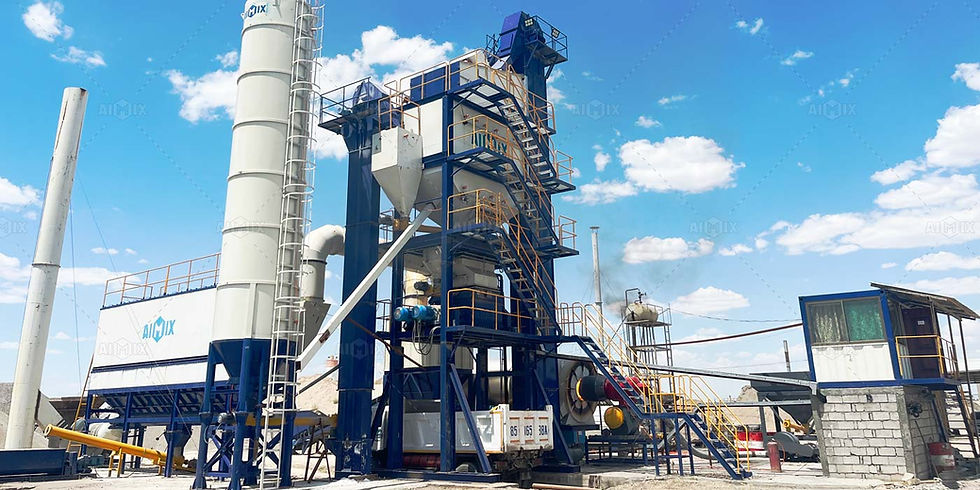
Turn The Calculation Into A Complete Asphalt Solution
Choosing an asphalt plant is only the beginning. A reliable road construction solution must connect aggregate preparation, asphalt production, transportation, paving, and compaction into one coordinated workflow.
At AIMIX, we can help contractors work backward from their road project requirements. For a 7 m wide road, we can calculate the approximate asphalt demand from road length, thickness, density, and daily paving targets. We can then discuss a suitable plant capacity, plant type, storage configuration, and supporting equipment.
If your project has a specific road length, paving schedule, asphalt mix, or haul distance, provide those figures before selecting the asphalt plant. A project-specific calculation can show whether an 80 t/h, 100 t/h, 120 t/h, 160 t/h, or another capacity better matches the actual construction plan.
The goal is not simply to install a larger asphalt plant. The goal is to keep the asphalt supply synchronized with the paver and complete the road within the required production schedule.

Comments