


Different Types of Crusher: How Industrial Crushing Requirements Differ From Aggregate Production
Industrial crushing and aggregate production both reduce large materials into smaller particles, but their processing objectives can be very different. Aggregate plants typically focus on producing graded stone for road construction, concrete, and asphalt, while industrial crushing may prepare raw materials for mineral processing, cement manufacturing, chemical production, or other downstream operations. These differences influence crusher selection, circuit design, particle-size requirements, and operating priorities. Understanding the final application is essential before choosing equipment or designing a complete crushing line. Get to know more information about different types of crushers from the following sections.

How Production Objectives Influence Crusher Selection
In aggregate production, the goal is usually to manufacture specific sizes of crushed stone at a consistent rate. Products may include coarse aggregate, road base, fine aggregate, and manufactured sand. Particle shape, gradation, and the proportion of fines can directly affect whether the material meets customer specifications.
Industrial crushing has a broader range of objectives. A cement plant may need to reduce limestone to a size suitable for raw meal preparation, while a mineral processing facility may require ore to reach a specific size before grinding or separation. Some industrial processes prioritize maximum throughput, while others focus on liberation size, controlled particle distribution, or minimizing excessive fines.
Consequently, the best crusher is not determined by material hardness alone. Feed size, required reduction ratio, downstream processing requirements, and the cost of producing each ton must also be considered.
Jaw Crushers for Primary Size Reduction
Jaw crushers are commonly used for primary crushing in both aggregate and industrial applications. Their compression-based mechanism allows them to handle large feed material and reduce it to a manageable size for subsequent processing.
In a quarry, a jaw crusher may receive blasted granite, basalt, or limestone before the material moves to secondary crushing and screening. In an industrial facility, it may reduce run-of-mine ore or other bulk raw materials before grinding, sorting, or further size reduction.
The required discharge size differs according to the next processing stage. An aggregate plant may need a feed size suitable for a cone or impact crusher, whereas an industrial plant may need material that can pass efficiently through a conveyor system or enter a grinding circuit.
When evaluating a jaw crusher for sale, buyers should examine the feed opening, allowable feed size, expected capacity, discharge-setting range, and material characteristics. A large feed opening does not guarantee high production if the downstream equipment cannot handle the resulting output. The complete process must be considered when selecting primary crushing equipment.
Cone Crushers for Secondary and Fine Crushing
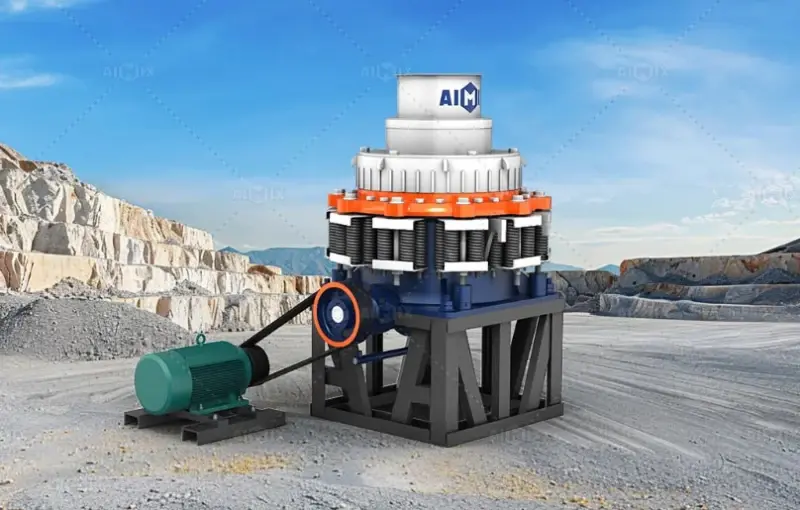
Cone crushers are widely used for secondary and tertiary crushing, particularly when processing hard or abrasive rock. They reduce material through compression between the mantle and concave, making them suitable for many granite, basalt, and ore applications.
In aggregate production, cone crushers help control the size distribution of crushed stone. When combined with suitable screening, they can produce several aggregate grades or operate in a closed circuit to return oversized material for further reduction.
Industrial applications may use cone crushers to prepare ore for grinding or other processing stages. However, the required discharge size and particle distribution depend on the downstream process. A circuit designed for road aggregate production may therefore differ significantly from one designed for mineral processing.
Anyone comparing a cone crusher for sale should consider the material's abrasiveness, required reduction ratio, feed-size distribution, target output, and expected circulating load. Operating costs also depend on wear-part life, energy consumption, maintenance requirements, and how consistently the machine is fed.
Why Screening and Downstream Processing Matter
Crusher selection is only one part of process design. Screening, conveying, storage, and downstream equipment determine whether the crushed material reaches its intended destination at the required rate and quality.
Aggregate plants often use vibrating screens to separate material into commercial size fractions. Oversized particles may return to the crusher, while finished fractions move to separate stockpiles. Screen efficiency directly affects product consistency and the amount of material recirculated through the circuit.
Industrial plants may use screens, feeders, magnetic separators, classifiers, or grinding equipment depending on the material and production objective. For example, mineral processing may require a controlled feed size before grinding, while cement manufacturing needs raw materials prepared for subsequent blending and processing.
In either setting, an undersized screen or conveyor can restrict the output of an otherwise adequately sized crusher. The effective capacity of a complete line is determined by its limiting stage, not simply by the nameplate capacity of its largest machine.
Energy Consumption and Operating Costs
Energy use and wear costs depend on the crushing mechanism, material properties, reduction ratio, and operating conditions. Hard, abrasive materials generally place greater demands on wear components than softer, less abrasive materials. Excessive reduction in a single stage may also increase energy consumption or produce an undesirable quantity of fines.
For aggregate producers, unnecessary fines can reduce the yield of saleable coarse products or require additional processing. For industrial operations, an unsuitable particle-size distribution may increase grinding energy or interfere with downstream separation.
Pre-screening can help in either application when it removes material that already meets the next stage's size requirements. However, screens and conveyors also consume energy and require maintenance. The benefits should be assessed across the entire process rather than assumed from the performance of one machine.
A useful comparison is the total operating cost per ton of acceptable output, including energy, wear parts, labor, maintenance, and the cost of handling off-specification material.
Match the Crushing System to the Industry
Different industrial sectors require different equipment combinations. Quarry and aggregate operations often prioritize product grading, particle shape, and flexible production of multiple sizes. Mining operations may emphasize feed preparation, reduction ratio, and compatibility with grinding or mineral separation. Cement plants require crushing arrangements suited to their raw materials and downstream production stages.
Before selecting equipment, operators should establish the feed material, maximum feed size, required output distribution, production target, and downstream process limits. Material testing and representative production data can help verify whether the proposed configuration is suitable.
A jaw crusher may provide the necessary primary reduction, while a cone crusher may handle subsequent size reduction. Other applications may require impact crushing, specialized industrial crushers, or additional screening and separation stages. No single crusher configuration is optimal for every material or production objective.

Choose Equipment Based on the Complete Process
The main difference between industrial crushing and aggregate production lies in what the crushed material must accomplish next. Aggregate plants generally need consistent, saleable size fractions, whereas industrial facilities prepare materials for a wider range of manufacturing and processing requirements.
Whether comparing a jaw crusher for sale or a cone crusher for sale, buyers should evaluate more than purchase price and rated capacity. The correct decision accounts for material properties, target particle size, downstream equipment, energy consumption, maintenance, and the cost of producing acceptable output.
A well-designed crushing system aligns every stage with the final application. This approach helps avoid capacity mismatches, unnecessary processing, and operating costs that can undermine the performance of the entire production line.


Comments