


Mobile Crusher Station Daily Output Calculation: Evaluating Working Hours, Equipment Availability, and Material Characteristics
Calculating the daily output of a mobile crusher station is essential for planning aggregate production, estimating operating costs, and meeting project delivery schedules. However, actual production depends on more than the equipment's rated capacity. Working hours, equipment availability, material properties, feeding conditions, and screening efficiency all influence how many tons of saleable aggregate a plant can produce in one day. A realistic calculation helps operators set achievable production targets and identify opportunities to improve performance.
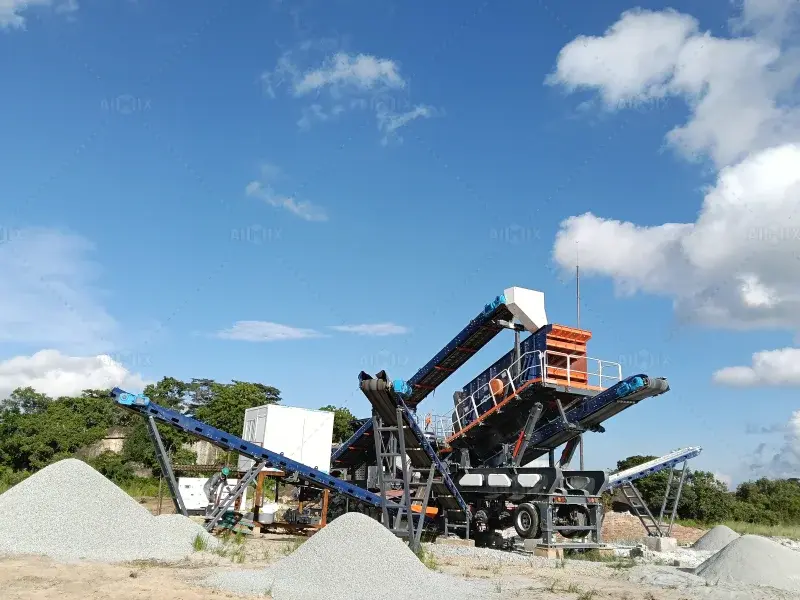
1. Start with the Rated Capacity and Effective Working Hours
The rated capacity of a mobile crusher station provides a reference for estimating its production potential. For example, a crushing unit rated at 150 TPH theoretically processes 150 tons of material per hour under specified operating conditions.
However, the plant does not necessarily produce at this rate throughout an entire shift. Operators must account for actual crushing time rather than simply multiplying rated capacity by total working hours.
A basic calculation is:
Theoretical daily output = Rated capacity × Effective crushing hours
If a 150 TPH mobile crusher operates for 8 effective hours, its theoretical daily output is:
150 × 8 = 1,200 tons.
This figure assumes continuous operation at rated capacity. In practice, feeding interruptions, material blockages, equipment adjustments, and other production losses reduce the actual result.
For accurate planning, effective crushing hours should exclude scheduled breaks, maintenance periods, equipment preparation, and other non-production time.
2. Include Equipment Availability in the Calculation
Equipment availability measures the proportion of scheduled operating time during which the crushing plant is ready to operate. Unexpected breakdowns, maintenance, hydraulic problems, and electrical failures can all reduce availability.
A more realistic formula is:
Estimated daily output = Rated capacity × Scheduled operating hours × Equipment availability × Operating efficiency
For example, consider a mobile crusher station with:
Rated capacity: 150 TPH
Scheduled operating time: 10 hours
Equipment availability: 90%
Operating efficiency: 80%
The estimated daily output is:
150 × 10 × 90% × 80% = 1,080 tons.
The availability factor accounts for equipment downtime, while operating efficiency reflects production losses during available operating time, such as irregular feeding and reduced processing rates. These factors should be calculated separately to avoid counting the same losses twice.
Tracking daily operating records allows quarry managers to identify whether low output results mainly from mechanical downtime or inefficient production practices.
3. Consider Material Characteristics and Feed Conditions
Different materials produce different crushing results even when processed by the same equipment. Hardness, abrasiveness, moisture content, feed size, and material shape all influence throughput.
For example, granite and basalt generally require more crushing effort than softer limestone. Highly abrasive materials can also accelerate wear on crushing components, gradually affecting production performance between maintenance intervals.
Feed size is another important factor. If raw materials frequently exceed the crusher's recommended maximum feed size, blockages and uneven crushing may occur. Excessively large rocks may also require secondary breaking before entering the crushing chamber.
Moisture content can create additional problems, particularly when processing clay-rich or wet materials. Sticky fines may accumulate around screens and discharge areas, reducing material flow and screening efficiency.
Operators should therefore use actual material test results and production records when estimating daily output instead of relying exclusively on the equipment's nominal capacity.

4. Match Mobile Jaw Crushers and Secondary Equipment
The configuration of a mobile crusher station determines how efficiently material moves through the production process. In a multi-stage plant, the capacity of each crushing unit must be balanced to prevent bottlenecks.
Mobile jaw crushers are commonly used for primary crushing because they can process large feed materials from quarry operations. Their actual output depends on feed size, material hardness, crusher settings, and the consistency of material supply.
After primary crushing, a mobile impact crusher may be used for secondary processing, particularly when producing aggregates with specific particle-shape requirements from suitable feed materials. However, its processing capacity must match the upstream jaw crusher's output.
For example, if a primary jaw crusher produces 150 tons per hour but the secondary impact crusher can process only 110 tons per hour under the same material conditions, the secondary stage becomes the production bottleneck.
A balanced configuration should consider:
Primary crusher capacity and maximum feed size.
Secondary crusher processing requirements.
Screening capacity and required product sizes.
Conveyor capacity between processing stages.
Recirculating material in closed-circuit operation.
The output of the complete plant is determined by its limiting processing stage, not simply the highest-rated crusher.
5. Account for Screening Efficiency and Saleable Output
Daily crushing output and daily saleable aggregate output are not always the same. Screening determines how much processed material meets the required product specifications.
In a closed-circuit system, oversized material is returned to the crusher for further processing. This recirculation increases the workload of the crushing equipment, even though the same material passes through the system more than once.
For example, a plant may process 1,000 tons of material internally during a shift but produce only 750 tons of finished aggregate that meets the required specifications. The remaining material may include recirculated material, unsuitable fines, or other products that do not meet the target requirements.
Operators should distinguish between:
Crusher throughput: Material passing through the crushing equipment.
Plant throughput: Material processed across the complete production line.
Saleable output: Finished aggregate meeting customer specifications.
For business planning and cost-per-ton calculations, saleable output is generally the most useful measurement because it reflects the quantity that can actually be delivered or sold.
6. Use Daily Production Records to Improve Output
Regular production monitoring helps operators compare calculated output with actual results. Instead of relying on occasional measurements, quarry managers should record key operating data for every shift.
Useful indicators include:
Total operating hours and effective crushing hours.
Equipment downtime and breakdown duration.
Raw material type, moisture, and feed size.
Total processed material and finished aggregate quantities.
Screening losses and recirculation rates.
Fuel or electricity consumption per ton.
These records help identify recurring production constraints. For instance, if a mobile crusher station regularly loses output because of insufficient feeding, improving loader coordination may be more effective than purchasing a larger crusher.
If screening is the limiting factor, upgrading the screen or adjusting the material flow may provide better results. Where equipment breakdowns are responsible for lost production, preventive maintenance and spare parts planning should receive priority.
7. Set Realistic Daily Production Targets
A practical daily production target should reflect the plant's actual operating conditions rather than its maximum rated capacity. Quarry operators should calculate expected output using historical performance, material test results, planned working hours, and equipment availability.
It is also useful to establish separate production targets for different materials and product specifications. Processing hard, abrasive rock may require different operating rates and maintenance intervals than crushing softer materials.
When project demand increases, operators can first evaluate whether the existing plant has opportunities to improve feeding, screening, equipment availability, or working-hour utilization. Additional crushing units should be considered only when the current production line cannot meet demand through operational improvements.

Conclusion
Accurate mobile crusher station daily output calculation requires more than multiplying rated capacity by working hours. Equipment availability, operating efficiency, material characteristics, crushing configuration, and screening performance all affect finished aggregate production. By monitoring these factors and calculating output based on saleable material, quarry operators can establish realistic production targets, control operating costs, and make better equipment investment decisions.


Comments