


What Asphalt Plant Capacity Is Required for Cold-Region Road Construction in Siberia?
- aimixglobal5
- Jan 28
- 5 min read
Siberia is not an easy place to build roads. Long winters, extremely low temperatures, frozen soil layers, and short construction seasons all put pressure on contractors and project owners. Under these conditions, choosing the right asphalt plant capacity is not a simple equipment decision. Instead, it becomes a core factor that affects project schedules, pavement quality, operating costs, and long-term road performance.
So, what asphalt plant capacity is really required for cold-region road construction in Siberia? The answer depends on climate conditions, project scale, paving rhythm, and how well the plant can maintain stable asphalt temperature. In this article, we will walk through these factors step by step, from a contractor’s real needs to practical capacity selection, and help you make a decision that is both realistic and cost-effective.

Understanding Siberia’s Cold-Region Construction Challenges
Before talking about capacity numbers, it is necessary to understand why Siberia is different. Climate shapes every technical choice in cold-region road construction.
Extremely Low Temperatures and Their Impact
In many Siberian regions, winter temperatures drop to -30°C or even lower. Even during the construction season, night temperatures can fall sharply. As a result, asphalt cools much faster than in temperate regions. If production and paving are not well synchronized, the mixture may lose workability before compaction.
Therefore, asphalt mixing plant equipment must not only produce enough mix but also maintain consistent output to avoid frequent stops and starts.
Short Construction Season Increases Pressure
Most road projects in Siberia have a limited window, often only 4–6 months per year. Contractors must complete earthwork, base layers, and asphalt paving in a compressed schedule. Because of this, daily asphalt output becomes critical.
This reality directly leads us to the next question: how much asphalt must be produced per hour to keep projects on track?
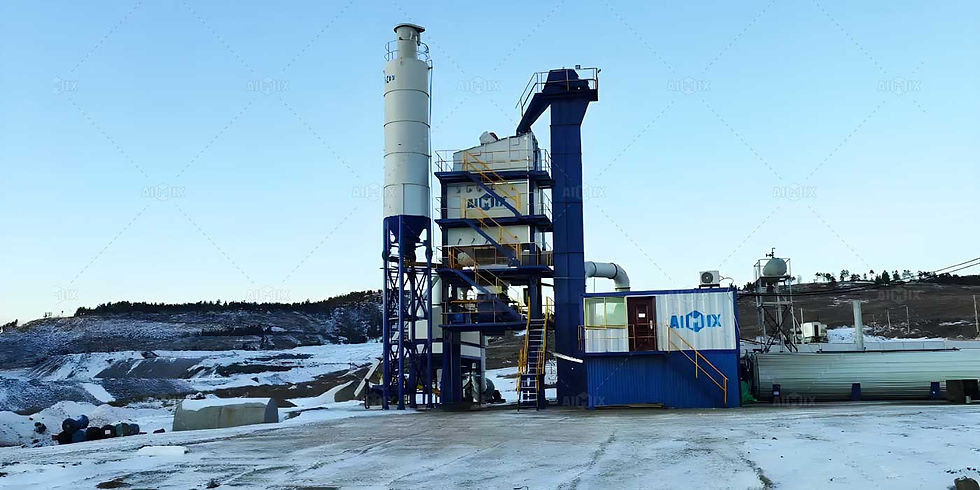
Why Asphalt Plant Capacity Matters More in Cold Regions
Once we understand the environment, the importance of plant capacity becomes clearer. Capacity is not just about volume. It affects temperature control, logistics efficiency, and labor utilization.
Maintaining Continuous Paving Operations
In cold regions, interruptions during paving can quickly lead to quality problems. Cold joints form easily, and compaction becomes less effective. A higher-capacity asphalt plant helps maintain continuous material supply, which keeps paving crews working steadily.
As a result, many Siberian contractors prefer slightly higher capacity than the theoretical minimum.
Reducing Heat Loss During Production and Transport
Higher-capacity plants often come with stronger burners, better insulation, and more advanced control systems. These features help maintain asphalt temperature from mixing to loading.
When output is stable and predictable, trucks spend less time waiting, and the asphalt reaches the site hotter and more workable.

Key Factors That Determine Required Asphalt Plant Capacity
Now that we see why capacity matters, we can break down how to calculate the right number. Several practical factors influence the final choice.
Project Scale and Daily Paving Volume
The first question every contractor asks is simple: how many tons of asphalt do we need per day?
For example, a regional highway project in Siberia may require 800–1,200 tons per day during peak paving. If the paving window is 8–10 hours, the required plant capacity often falls between 120 and 160 t/h.
Smaller municipal roads may need only 200–400 tons per day, which makes a 40–80 t/h central hot mix plant more realistic.
Construction Rhythm and Working Hours
However, daily volume alone is not enough. You also need to consider how many effective working hours you actually have.
In cold regions, weather disruptions are common. Sudden rain, wind, or temperature drops can stop paving. Therefore, many contractors prefer higher hourly capacity so they can compensate for lost time on good days.
This is why a plant with 120 t/h capacity may be chosen even when calculations suggest 90 t/h is sufficient.
Distance Between Plant and Paving Site
Transport distance plays a larger role in Siberia than in warmer regions. Longer hauling distances increase heat loss and cycle time.
If trucks need 40–60 minutes per trip, the plant must load efficiently and avoid bottlenecks. A higher-capacity plant reduces truck waiting time and improves overall logistics efficiency.

Typical Asphalt Plant Capacity Ranges for Siberian Projects
Based on real-world cold-region projects, we can group asphalt plant capacity into practical ranges.
Small-Scale and Municipal Road Projects
For town roads, village connections, or maintenance projects, capacity requirements are usually modest.
Recommended capacity: 40–80 t/h.
These plants are often mobile or compact stationary units. They offer flexibility, faster installation, and lower investment costs. In cold regions, contractors should still prioritize good insulation and reliable burners.
Regional Roads and Secondary Highways
As project size increases, so do capacity demands.
Recommended capacity: 100–160 t/h.
This range suits most regional highways in Siberia. It balances productivity with fuel efficiency. More importantly, it allows contractors to pave intensively during favorable weather windows.
Major Highways and Long-Distance Projects
For federal highways or long-distance corridors, output requirements are much higher.
Recommended capacity: 200–320 t/h.
These plants usually feature advanced control systems, large hot aggregate storage, and strong burners. They support continuous, high-volume paving, which is essential for meeting strict deadlines.

Cold-Region Features That Matter More Than Nominal Capacity
Capacity numbers alone do not tell the full story. In Siberia, certain technical features become equally important.
Burner Performance and Fuel Flexibility
A powerful burner ensures aggregates reach target temperature quickly. Fuel flexibility, such as diesel or heavy oil options, helps contractors adapt to local fuel availability.
Stable heating directly supports consistent output, even in cold ambient conditions.
Thermal Insulation and Heat Preservation
Well-insulated dryers, hot bins, and asphalt storage silos reduce heat loss. This feature allows the plant to maintain mixture temperature without excessive fuel consumption.
In practice, good insulation can make a medium-capacity plant perform like a larger one in cold environments.
Automation and Control Systems
Accurate weighing and automatic control reduce human error. They also help maintain consistent mix quality during long production runs.
Consistency matters more in cold regions, where temperature fluctuations already add complexity.

From Contractor’s Perspective: Balancing Cost and Performance
Every contractor must balance investment cost with operational performance. Oversizing increases capital expense, while undersizing risks delays and quality issues.
In Siberia, many experienced contractors follow a practical rule: choose a plant with 20–30% higher capacity than the calculated minimum.
This margin provides flexibility, reduces stress during peak periods, and protects the project against weather uncertainty.
How We Support Cold-Region Asphalt Projects
As an asphalt plant manufacturer and solution provider, we work closely with contractors operating in cold and extreme environments. We do not simply recommend the largest plant. Instead, we analyze project scale, climate conditions, transport distance, and construction rhythm.
Our asphalt plants for cold regions focus on stable output, strong heating systems, reliable insulation, and user-friendly automation. These features help clients achieve consistent paving quality within short construction seasons.

Final Thoughts: Choosing the Right Capacity for Siberia
So, what asphalt plant capacity is required for cold-region road construction in Siberia? There is no single number. However, most projects fall within 80–320 t/h, depending on scale and schedule.
The key is to look beyond theoretical calculations. Consider climate risks, transport distance, and the value of uninterrupted paving. When you align capacity with real construction conditions, you protect both your schedule and your pavement quality.
If you are planning a road project in Siberia or other cold regions, choosing the right asphalt plant capacity is the first step toward long-term success. We are ready to help you evaluate your project and provide a solution that fits your needs, your budget, and your construction reality.


Comments